

What does a Democratic Congress paired with a Republican president mean for investments that don't trade on a stock exchange, like real estate, housing-backed bonds, and private credit?
Stock market swings grab the headlines after any election, and they'll keep coming as investors sort out what a split Washington means. But if part of your money sits in alternative investments, the questions that matter are different: tax rules, housing policy, interest rates and regulation.
What changed in Washington
 Democrats flipped seven Senate seats (with 1 still undecided at the time of this writing), and more than two dozen House districts. Starting in January, they'll control both chambers for the final two years of President Trump's term.
That means gridlock. Democrats gain subpoena power and more say over federal spending, but the president still holds the veto, and Democrats are well short of the 60 Senate votes needed to get past a filibuster. Big, sweeping laws from either side just got much harder to pass. For long-term investors, that can be a feature, not a bug.
Why Wall Street often shrugs at gridlock
History has been kind to the year after a midterm. Since 1950, the S&P 500 was higher 12 months after all 19 midterm elections, according to Pepperstone, though the ride was rarely smooth. History has been kind to the year after a midterm. Since 1950, the S&P 500 was higher 12 months after all 19 midterm elections, with an average gain of about 15%, according to Pepperstone. A Motley Fool review going back to 1874 found that when a midterm produced divided government under a Republican president, exactly the setup we have now, the market was positive the following year 93% of the time.
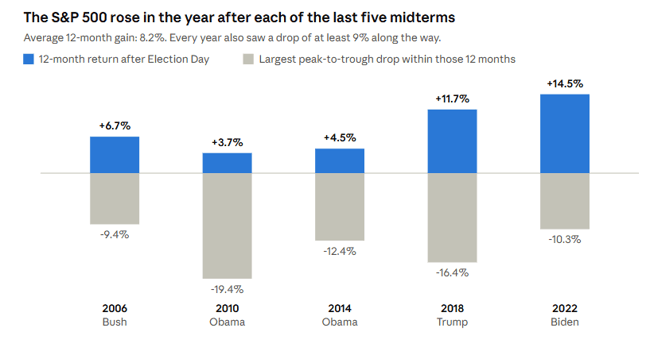
Every one of the last five midterms was followed by a gain, but each year also included a drop of 9% or more along the way. And the research on whether gridlock actually calms stock markets is mixed: some studies have linked divided government to higher volatility.
Private real estate tells a steadier story. Cushman & Wakefield found that private commercial real estate delivered positive returns after 10 of the last 12 midterms, and that party control made little difference: average returns were 8.8% under unified government and 8.6% under divided government. Their conclusion is that economic growth, interest rates, and credit availability matter far more than the election itself.
Four ways the midterms touch alternative investments
-
Real estate tax rules are likely locked in. Last year's tax law made Opportunity Zones permanent, kept 1031 like-kind exchanges intact, and made the 20% qualified business income deduction permanent. A Democratic Congress can't easily roll those back while a Republican president holds the veto pen. For investors who plan holdings over five or ten years, that stability matters.
-
Housing is the rare bipartisan priority. The 21st Century ROAD to Housing Act passed with overwhelming support this summer, and Democratic leaders have named housing costs a top priority for 2027. Some lawmakers are already discussing a follow-up bill to expand homebuilding. Estimates of the shortage vary widely, but Realtor.com puts it at about 4 million homes. That gap won't close in one Congress, which keeps underlying demand for housing strong.
-
Interest rates still drive income. Mortgage rates remain well above their pandemic-era lows, and the Federal Reserve, not the election, will do most of the steering from here. Elevated rates are hard on borrowers, but they also mean higher income for lenders, including investors in real estate debt.
-
Private markets face a closer look. The administration has been opening 401(k) plans to alternatives like private credit, and Democrats have pushed back, warning about fees, liquidity, and transparency. With control of Congress, they can hold hearings and press regulators, and industry observers expect that push to slow. Expect more questions about how private funds are valued and how easily investors can withdraw. Those are worth asking about any investment you hold.
What to watch in the months ahead
Three developments will say a lot about where alternatives go next:
-
The Fed's December meeting, for the next signal on interest rates.
-
A follow-up housing bill, and whether it gains traction in the new Congress.
-
The Labor Department's proposed 401(k) rule on alternative assets, and how it fares under a Democratic Congress.
The Bottom Line
It's natural to feel like an election should change your financial plan. Usually, it shouldn't. For alternative investments especially, what matters most is what the election didn't change: real estate tax rules, the housing shortage, and the central role of interest rates.
 If the next two years bring more headline whiplash, use it as a prompt to review your whole portfolio. Ask how much of it rides on daily market moves, and whether income-producing investments backed by real assets like housing have a place in your plan. Keep in mind that these investments are usually less liquid than stocks, and every investment carries risk.
This article is for informational purposes only and is not investment advice. Past performance does not guarantee future results.
Sources
- CNN: Dow has best post-midterm day in 44 years
- CNBC: Democrats sweep 2026 midterms
- MS NOW: Democrats win House and Senate
- Pepperstone: Do stocks rally after midterms? 19 elections tested
- Motley Fool via WSB-TV: midterms and the stock market since 1874
- Institutional Investor: Oxford study on divided government
- Revista Española de Ciencia Política: divided government and volatility
- CFRA via Seeking Alpha: S&P 500 returns by political scenario
- AP via Times Free Press: stocks surge after midterms
- NBC: healthcare fights after the midterm sweep
- Realtor.com via Barchart: housing supply gap tops 4 million homes
- IG: midterms and the rates trade
- The Sun: US housing bill to become law despite Trump snub